
Executive summary
Indian family offices have undergone a decisive transformation over the past decade. What were once informal wealth-holding structures attached to operating businesses have evolved into professionally managed, globally active investment platforms. Based on QVSCL’s proprietary dataset of 303 Indian single family offices established worldwide, this report maps the full landscape of Indian promoter capital — from legacy industrial dynasties dating back to the early 20th century to new-age technology founders who formalised their family offices post-IPO in 2024–2025.
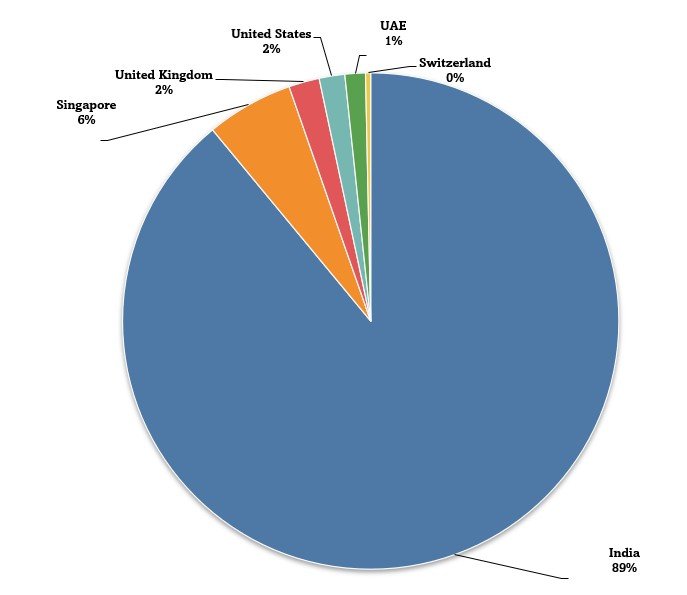
The data reveals several structural shifts: over 80% of Indian family offices were established after 2016, driven by a surge in entrepreneurial liquidity events, rising UHNW wealth, and a growing appetite for alternative investments. While India remains the dominant base (accounting for 89% of offices), Singapore, the UAE, the United States, the United Kingdom, and Switzerland together host a growing offshore contingent. GIFT City’s emergence as a regulated domestic-offshore jurisdiction adds a new dimension to this evolving map.
Introduction: The Rise of Indian Family Offices
India’s family office ecosystem has expanded from an estimated 45 structures in 2018 to over 300 by early 2026, according to PwC, EY, and industry databases. This growth parallels the rapid expansion of India’s ultra-high-net-worth population — now the world’s fastest growing, with projections of a 50% increase by 2028.
The catalyst has been a fundamental shift in how Indian business families manage wealth. The new generation — often educated abroad, tech-savvy, and exposed to global capital markets — has driven the formalisation of family offices as distinct entities. This has been accelerated by landmark liquidity events: the Flipkart acquisition, the Paytm and Nykaa IPOs, the Zomato and Swiggy listings, and hundreds of smaller entrepreneurial exits.
Indian family offices have become significant participants in the startup ecosystem. Industry estimates suggest family offices may have contributed upwards of $9 billion to Indian startup funding in 2024–25 alone — approximately 35–40% of total domestic venture capital inflows.
Data Insights: What the Dataset Reveals
Global Jurisdiction Map
India remains the dominant base at 89%. Singapore is the preferred offshore hub with 17 offices, followed by the UK (6), the US (5), the UAE (4), GIFT City (3), and Switzerland (1).
Key Insight: Singapore’s appeal lies in regulatory clarity under MAS. GIFT City’s FIF framework under IFSCA (2025) is expected to accelerate domestic offshore structuring.
Investment Sector Patterns
Consumer-focused investments appear in 142 offices (47%), followed by Technology (86), Fintech (54), Healthcare (35), Real Estate (34), D2C (30), and AI (26). EV, SaaS, and Climate/ESG are growing rapidly.
Global Jurisdiction Strategy
- Primary base — proximity to operating businesses and promoters
- Deep understanding of domestic markets and strong deal flow
- Access to private equity, venture capital, and real estate
- GIFT City emerging as a domestic offshore equivalent
- Regulatory clarity under the Monetary Authority of Singapore (MAS)
- Robust private banking, fund administration, and legal ecosystem
- Efficient structuring for cross-border investments
- Most preferred offshore hub — gateway to Southeast Asia and Asia-Pacific
- Zero personal income tax environment
- Investor-friendly jurisdictions: DIFC and ADGM
- Geographic and cultural proximity to India
- Growing access to Middle East capital and co-investors
- Access to global technology and innovation ecosystems
- Direct investment in venture and growth-stage companies
- Participation in mature capital markets with strong governance
- Stable legal and governance frameworks rooted in English common law
- Access to global financial markets from London
- Strong historical ties with India’s business community
- Centuries-old expertise in wealth preservation and estate planning
- World-class private banking infrastructure
- Long-term capital protection and political neutrality
Key Trends Emerging From the Data
- Institutionalisation of Promoter Capital
Over 80% of offices were established post-2016, reflecting a generational shift toward institutional governance, dedicated investment teams, and defined mandates.
- Global Diversification
Singapore, Dubai, London, and GIFT City have emerged as strategic hubs. Many families now operate dual structures — onshore for rupee-denominated assets and offshore for global diversification.
- Technology and Venture Exposure
Technology appears in 86 offices (28%), Fintech in 54, AI in 26. Family offices have become the single largest domestic source of patient capital for startups.
- New-Age Founder Wealth
Founders of Zerodha, Flipkart, Zomato, PhonePe, CRED, Dream11, Lenskart, and others have formalised family offices following IPOs, acquisitions, or secondary sales.
- GIFT City as Domestic Offshore
IFSCA Fund Management Regulations (2025) created a formal FIF framework. PremjiInvest and Catamaran Ventures are among the first to register.
- Cross-Border Structuring
Families are navigating FEMA, LRS, and OI frameworks to build multi-jurisdictional structures focused on regulatory clarity and long-term capital mobility.
Future Outlook
The Indian family office ecosystem is at an inflection point. With India’s UHNW population projected to grow 50% by 2028 and the number of family offices expected to cross 1,000 within the next five years, the landscape will continue to evolve rapidly. Regulatory developments in GIFT City, the growing sophistication of next-generation family members, and continued startup liquidity events will shape this trajectory.
For founders, investors, and intermediaries working with Indian capital, understanding this evolving landscape is essential. The Indian family office is no longer a passive wealth repository. It is an active, globally connected, and increasingly influential force in private capital markets.

Get your Business
Right up There
Businesses adviced over 4+ years
Achieved measurable growth
Positive outcomes achieved
From your problem
To real solution
STEP 1Your Problem
STEP 2Our Observance
STEP 3Our Suggestions
STEP 4Your Success

CONTACT US WITH EASEGet in touch
Sector-60 Gurugram
+91 9810646388
lalit.h@qvscl.com