

The Strategy - Execution Gap
Why so few companies are good at both-and what leaders can do about it
A strategy can look compelling in the boardroom and still fail to change what happens across the business. Equally, a well-run operation can deliver efficiently against a direction that is no longer right. The challenge for leadership teams is not simply to formulate a strategy or to execute a plan; it is to connect the two so that choices, resources, decisions and everyday work reinforce the same priorities.
The uncommon combination: good strategy and good execution
In our experience advising more than 200 companies over the past two decades, only around 10% sit in the green quadrant: organisations that combine a good strategy with strong execution. The accompanying matrix captures a broader pattern we see in practice-many companies have one capability without the other, while a substantial group struggles with both.
This practitioner estimate is consistent with, though not directly equivalent to, independent research. A 2013 Strategy& survey of nearly 700 executives found that only 8% rated their top leaders as very effective at both strategy and execution. The study assessed leaders rather than companies, so the figures should be read as a close parallel—not as the same measure. McKinsey’s analysis also highlights how difficult it is for companies to move from average performance into the top tier: the odds of moving from the middle quintiles to the top quintile over a decade were estimated at 8%, or one in twelve.
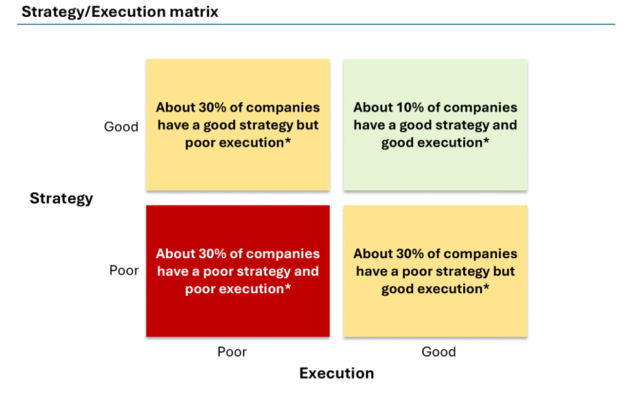
Figure 1. Strategy/execution matrix. The quadrant percentages reflect QVSCL consultants’ experience and are estimates, not a published industry-wide distribution.
Four positions and four different management challenges
1. Good strategy, poor execution: the plan does not become reality
These companies may understand where to compete and how they intend to win, yet struggle to turn that direction into coordinated action. Priorities multiply, budgets and people remain tied to legacy activities, and business units interpret the plan differently. Strategy& research found that 74% of surveyed executives worried their organisation had not translated strategy into tangible actions, while the same share felt it had too many priorities.
The answer is rarely another presentation. Leaders need to translate strategic choices into a short list of measurable outcomes, assign clear ownership, align resources and establish a review rhythm that resolves obstacles rather than merely reports progress.
2. Poor strategy, good execution: efficiency in the wrong direction
Operational discipline is valuable but it cannot compensate for a weak strategic choice. An organisation can meet targets, control costs and deliver projects on time while investing in markets, products or capabilities that do not create a durable advantage. In this quadrant, the organisation may be busy and efficient without making enough progress on the outcomes that matter.
The leadership task is to revisit the strategic diagnosis: what challenge are we solving, where will we focus, and what will we deliberately not do? Richard Rumelt’s framework for good strategy emphasises a clear diagnosis, a guiding policy and coherent actions. Goals and slogans alone are not a strategy.
3. Poor strategy, poor execution: activity without traction
This is the most difficult quadrant. If the strategic direction is unclear and the organisation also struggles to deliver, teams can spend significant energy reacting to urgent issues, launching disconnected initiatives and changing priorities. The first step is an honest reset not a blanket call for people to work harder.
Leaders should clarify the core business challenge, make explicit choices, stop low-value initiatives and build a realistic implementation plan. Trying to repair execution before agreeing on the right direction can lock the organisation into doing the wrong things more efficiently.
4. Good strategy, good execution: a reinforcing system
Companies in the green quadrant do more than produce a strong plan and then hand it to operations. They connect strategic choices to daily decisions. Priorities are understood, resources follow those priorities, cross-functional dependencies are managed and leaders adapt when evidence changes. The result is a system in which strategy shapes execution and lessons from execution sharpen strategy.
Why execution breaks down
Execution problems are often described as a lack of accountability or insufficient effort. Research suggests the causes are more structural. In a Harvard Business Review study drawing on 7,600 managers across 262 companies, 55% of middle managers could not name even one of their organisation’s top five priorities. Only 11% said all strategic priorities had the resources they needed, and only 9% said they could always rely on colleagues in other functions.
These findings point to four recurring gaps:
- Too many priorities: when everything is important, teams cannot distinguish what must come first.
- Resources out of alignment: budgets, talent and management attention do not move with the strategy.
- Siloed execution: teams optimise their own targets while cross-functional work stalls.
- Unclear decision rights and information flows: people do not know who can decide, or the information needed to act arrives too late.
The practical implication is important: execution is not just a downstream operational activity. Decision-making, information sharing, resource allocation and coordination are part of the strategy system itself.
The value lost in the strategy-to-results journey
In their Harvard Business Review article “Turning Great Strategy into Great Performance,” Chris Bradley and colleagues’ frequently cited predecessor analysis by Michael Mankins and Richard Steele reported that companies typically realised only about 63% of the financial performance their strategies promised. The gap is a reminder that a strategy’s value is not created when it is approved; it is created when the organisation consistently turns choices into results.
The number should not be treated as a universal current benchmark for every company. Its enduring lesson is diagnostic: when results disappoint, leaders should determine whether the strategy was flawed, execution was weak, or both. Without that diagnosis, organisations risk responding to the wrong problem.
A practical agenda for leadership teams
- Make the strategic choices explicit. State the challenge, where the business will focus, how it will create advantage and what it will stop doing. If teams cannot explain the choices in plain language, the strategy is not yet actionable.
- Reduce the priority list. Identify a small number of enterprise priorities and define what success looks like for each. Translate them into specific actions, milestones and accountable owners.
- Align resources with intent. Test whether budgets, leadership time, talent and capital actually support the stated priorities. Resolve the trade-offs rather than adding initiatives on top of existing commitments.
- Clarify decision rights and cross-functional ownership. Make clear who decides, who contributes and how disagreements are resolved. Assign shared outcomes where delivery depends on multiple functions.
- Build a review rhythm that enables action. Use a small set of leading and lagging indicators. Reviews should surface assumptions, remove blockers and trigger decisions not simply explain missed targets after the fact.
- Learn and adapt. Treat execution as a source of strategic information. When assumptions fail, revisit the choices instead of demanding more effort from teams working against an outdated plan.
A useful caveat: strategy and execution are not separate worlds
The matrix is a useful diagnostic, but it should not become a rigid division between “thinking” and “doing.” Roger Martin has argued that separating strategy from execution can itself create confusion: choices need to be made with implementation in mind, and the realities of implementation should inform strategic choices. Likewise, the often-repeated claim that 90% of strategies fail is not supported by a definitive, agreed failure rate. A 2015 review by Cândido and Santos concluded that published estimates vary widely and that the true rate remains undetermined. The more useful question is not whether a company belongs to a universal failure statistic, but where its own strategy-to-results system is breaking down.
QVSCL perspective: diagnose before prescribing
At QVSCL, we see the strategy-execution gap as a management-system challenge, not simply a planning issue. The right intervention depends on the quadrant: some organisations need sharper strategic choices; others need stronger execution discipline, clearer accountability, better resource alignment or more effective cross-functional decision-making. A structured diagnostic can help leadership teams identify the binding constraint and focus effort where it can create the greatest impact.
The objective is not to produce a more elaborate strategy document. It is to build the organisational capability to make clear choices, translate them into action, track outcomes and adapt as conditions change.
The bottom line
Strategy without execution is a promise; execution without strategy is effort without direction.
The companies that outperform are not necessarily those with the most ambitious plans or the busiest teams. They are the ones that connect strategic clarity with the people, resources, decisions and routines required to deliver. For leaders, the first step is to identify honestly which quadrant their organisation occupies and then address the problem it actually has.

Get your Business
Right up There
Businesses adviced over 4+ years
Achieved measurable growth
Positive outcomes achieved
From your problem
To real solution
STEP 1Your Problem
STEP 2Our Observance
STEP 3Our Suggestions
STEP 4Your Success

CONTACT US WITH EASEGet in touch
Sector-60 Gurugram
+91 9810646388
lalit.h@qvscl.com